A Brief Overview on Multi-component Synthesis of Tri- and Tetra-substituted Imidazoles
Sourav Dey
Department of Chemistry, University of North Bengal, Dist- Darjeeling, West Bengal, India.
Koushik Chakraborty
Department of Chemistry, University of North Bengal, Dist- Darjeeling, West Bengal, India.
Kiran Pradhan
Department of Chemistry, University of North Bengal, Dist- Darjeeling, West Bengal, India.
Pranab Ghosh *
Department of Chemistry, University of North Bengal, Dist- Darjeeling, West Bengal, India.
*Author to whom correspondence should be addressed.
Abstract
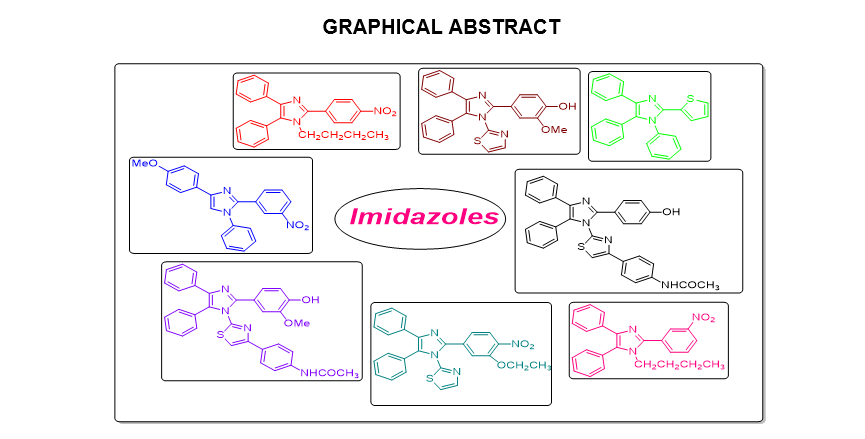
Imidazole ring is a five-membered aromatic heterocycle which is widely present in natural products to synthetic molecules. The imidazoles are a group of heterocyclic molecules that have diverse significance in the modern world due to its potentiality and various pharmacological applications. They are relevanat in the production of commercial drugs and the treatments of various disease conditions. The imidazole nucleus is present in many natural compounds and widely distributed in essential amino acids also. Their derivatives exhibit powerful pharmacological properties and they readily bind with a variety of enzymes and receptors in biological systems through diverse weak interactions, thereby exhibiting broad bioactivities. In this review, we evolved the historical timeline and development of synthetic pathways for tri- and tetra-substituted imidazoles using various kinds of catalysts. This work contains exploration of various biological and pharmacological applications documented in the literature useful for imidazole-based drug discovery. According to literature, tri- or tetra- substituted imidazole derivatives show strong potential for new synthetic methods and this work systematically gives a brief review in recent developments of tri- and tetra- substituted imidazole-based compounds in the whole range of pharmacological application which is helpful for new thoughts in the quest for rational designs of more active imidazole-based medicinal drugs, as well as more effective diagnostic agents and pathologic probes.
Keywords: Tri-tetra-substituted imidazoles, multi-component reactions, One-pot methods, Biological importances