Derivative UV Visible Spectroscopy for Improved Spectral Resolution and Data Analysis: A Mini Review
C.A. Sri Ranjani
Department of Pharmaceutical Analysis, RBVRR Women’s College of Pharmacy, Barkatpura, Hyderabad -500027, Telangana, India.
P. Revathi
Department of Pharmaceutical Analysis, RBVRR Women’s College of Pharmacy, Barkatpura, Hyderabad -500027, Telangana, India.
Khagga Bhavya Sri *
Department of Pharmaceutical Analysis, RBVRR Women’s College of Pharmacy, Barkatpura, Hyderabad -500027, Telangana, India.
*Author to whom correspondence should be addressed.
Abstract
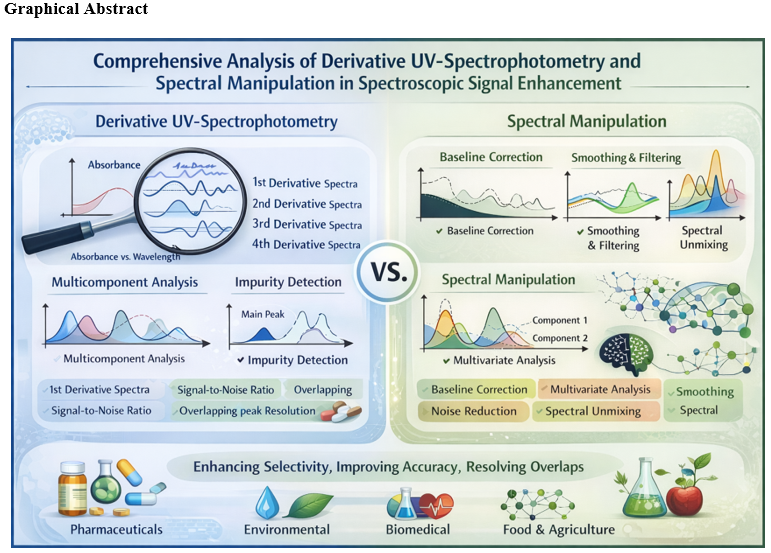
Theoretical variants of Derivative UV-Spectrophotometry are covered in the review paper. The method increases importance by utilizing the wavelength-dependent first and second derivatives of the transmission spectra. The known numerical derivatives are contrasted with the obtained optical derivatives. After that, the derivative spectra from first to fourth are examined. This provides important insight into the applications and constraints of this method for chemical analysis. Methods of measurement and derivative spectrum extraction are described. The degree of polynomial applied to the signal-to-noise ratio and derivative spectra's smoothness is expressed. The use of UV derivative spectrometry to ensure both single and multicomponent analysis is demonstrated. The selection and sense of determination that have been demonstrated are likely improved by derivative spectrophotometry. Derivative spectroscopy converts normal spectra into higher-order forms, while spectral manipulation involves mathematical processing for better interpretation of data. Together, they are widely applied in pharmaceutical, food, and chemical analysis for precise qualitative and quantitative measurements.
A wide range of mathematical and computational methods are used to improve the interpretability, accuracy, and analytical performance of raw spectroscopic data. This process is known as "spectral manipulation." This paper provides a thorough analysis of the basic ideas, procedures, and uses of spectrum manipulation in a variety of spectroscopic platforms, such as mass spectrometry, Raman, infrared (IR), near-infrared (NIR), and ultraviolet–visible (UV–Vis). Enhancement of weak or hidden spectrum information, decrease of background interference, and better resolution of overlapping signals are all made possible by spectral manipulation, which modifies spectral properties through data processing.
Keywords: Derivative spectra, area under curve, signal enhancement techniques, overlapping peak resolution, UV derivative spectrometry